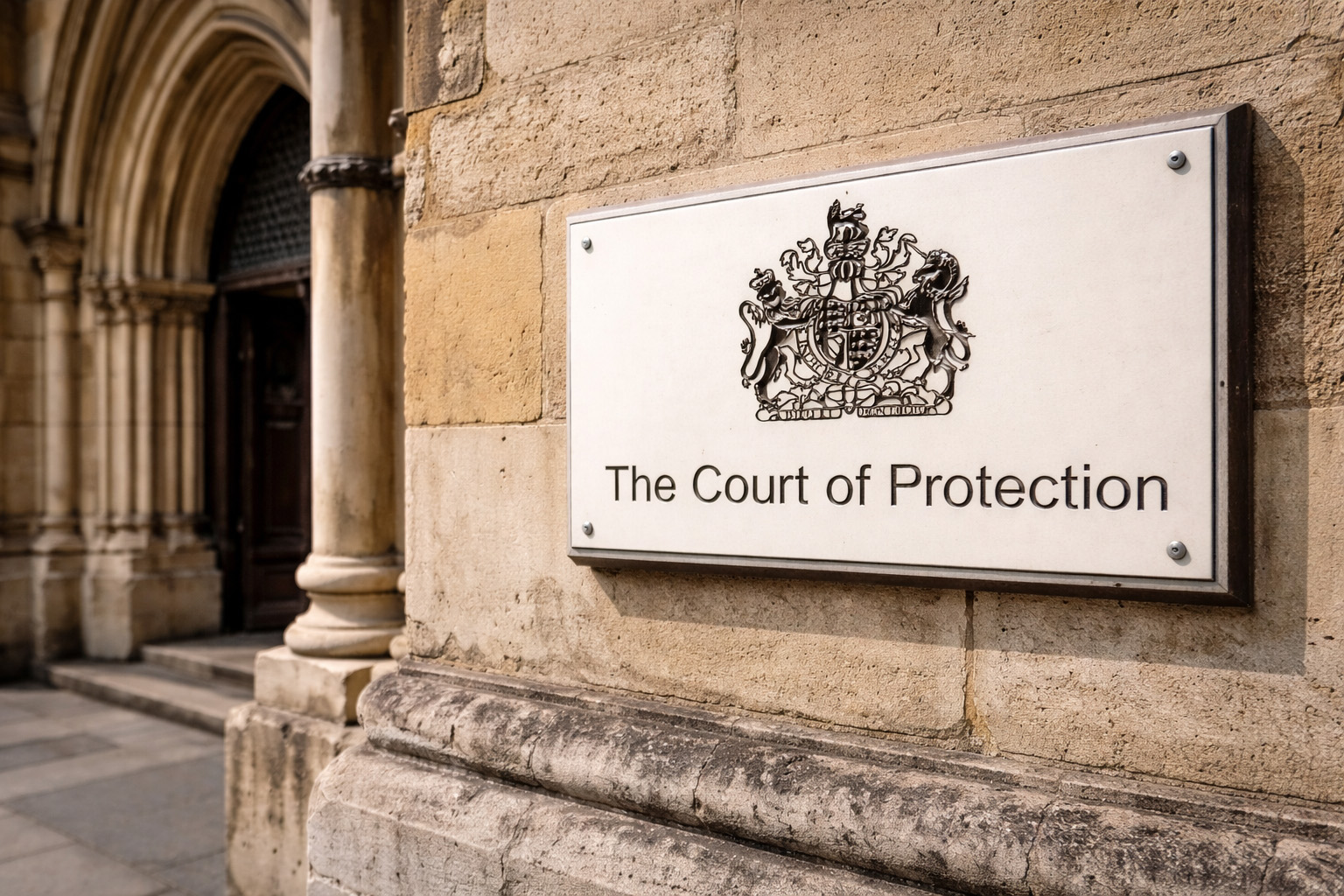
Applications to the Court of Protection allow decisions to be made about a person’s finances, property, health or welfare, either on an ongoing basis through a deputyship or for a specific, one-off issue. This article explains what the Court of Protection does, when an application may be needed, and what the application process entails.
What is the Court of Protection?
The Court of Protection is a specialist court in England and Wales. It makes decisions for adults aged 16 and over who lack the mental capacity to make certain decisions for themselves. Mental capacity is assessed in accordance with the Mental Capacity Act 2005, which sets out the legal framework for decision-making on behalf of vulnerable adults.
The Court’s role is not to take control unnecessarily, but to ensure that decisions are made lawfully, proportionately, and in the individual’s best interests. The person at the centre of proceedings is referred to as “P” in court documents.
When might an application be necessary?
An application to the Court of Protection is usually a last resort. In many cases, it can be avoided if the individual made a valid Lasting Power of Attorney while they still had capacity. Where no such arrangements exist, the Court can step in to provide authority and clarity.
Applications are commonly made where decisions are required about:
- Mental capacity, for example, where there is disagreement about whether P can make a particular decision.
- Property and financial affairs, such as managing bank accounts, paying bills, or selling a property.
- Health and welfare, although these deputyships are less common and usually limited to specific circumstances.
- One-off decisions, including statutory wills, large gifts, or authority to complete a particular transaction.
- Urgent or emergency situations, such as time-sensitive medical treatment or safeguarding concerns.
- Disputes, where family members or professionals cannot agree on what is in P’s best interests.
Who can apply to the Court of Protection?
Anyone aged 18 or older can apply to be a deputy, although most applicants are close family members or trusted friends. In some cases, particularly where finances are complex or there are disputes, a professional deputy, such as a solicitor, may be appointed.
Whoever applies must be suitable for the role and willing to take on the responsibilities that come with acting under the Court’s authority.
The application process explained
Applying to the Court of Protection involves several formal stages and can take several months from start to finish.
Preparing the application
The application begins with completing the relevant court forms. These usually include:
- COP1, the main application form.
- COP3, a capacity assessment completed by a medical professional or other suitably qualified person.
- COP4, the deputy’s declaration, confirming their understanding of the role and duties.
For property and financial affairs applications, additional financial information is required using COP1A, which details P’s assets, income, and liabilities.
Submitting the application and paying the fee
Once the forms are completed, they are submitted to the Court, along with the application fee. The fee is currently around £400, although fee reductions or exemptions may be available, depending on P’s financial circumstances.
Notifying P and others
After the Court issues the application, the applicant must formally notify P and at least three other people with an interest in P’s welfare. This is a key safeguard, allowing those notified to raise concerns or objections within a set period, usually 14 days.
Court consideration and possible hearings
Once the notification period has passed, the Court reviews the application. In straightforward cases, a decision may be made on the papers. If there are objections, complex issues, or disputes, the Court may request further information or schedule a hearing.
The court order and security bond
If the application is approved, the Court issues an order setting out what the deputy is authorised to do. Before the order becomes final, the deputy may be required to arrange a security bond. This serves as insurance to protect P’s finances against misuse or mismanagement.
Responsibilities after appointment
Once appointed, a deputy must always act in P’s best interests and within the limits of the Court order. The Office of the Public Guardian supervises deputies and must submit annual reports explaining their decisions and how P’s money or welfare has been managed.
The role carries significant legal responsibility, and deputies can be held accountable if they fail to fulfil their duties.
Why legal advice is often essential
Court of Protection applications are detailed, document-heavy, and tightly regulated. Errors or omissions can lead to delays, additional costs, or the application being refused. For that reason, many applicants choose to work with a solicitor experienced in Court of Protection matters.
A solicitor can advise on whether an application is necessary, help prepare the paperwork, manage the notification process, and guide deputies on their ongoing responsibilities. If you are considering an application, speaking to your solicitor at an early stage can clarify the process and make it more manageable.